



Industry Trends
Largest Transactions Closed
- Target
- Buyer
- Value($mm)

Advised Western Milling in their sale to the Western Milling ESOP Trust


Last updated:
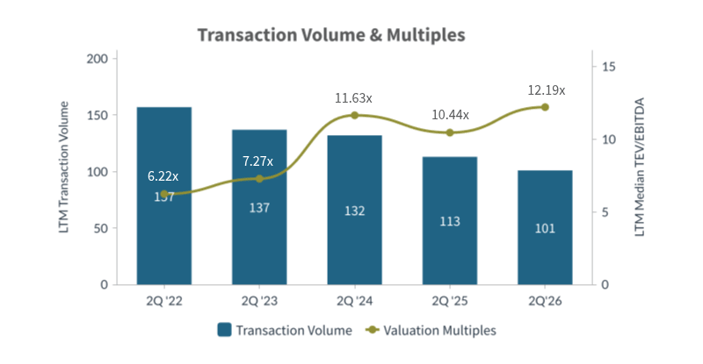
The Transportation & Logistics sector saw a continued moderation in M&A activity, with 101 transactions closed in the LTM period ending Q2 2026, down from 113 in the prior year. Strategic buyers continued to dominate the market, accounting for 79.2% of all deals, reflecting ongoing consolidation and capability-driven acquisition strategies.
"We're no longer seeing buyers chase volume; they're chasing defensibility," said Mike Rosendahl, Managing Director at PCE. "The assets drawing the most serious attention are those with contracted revenue, cross-border infrastructure exposure, or technology integration that can't be easily replicated. Owners who have invested in those capabilities are entering a seller's market, regardless of broader deal flow conditions."

The conflict involving Iran has introduced significant headwinds for the transportation and logistics industry, with surging diesel prices, elevated freight surcharges, and extended ocean shipping routes adding cost and complexity across supply chains. At the same time, uncertainty in global logistics has reinforced the importance of strategic cross-border investments, as seen by Grupo Aeroportuario del Pacífico’s $2.2 billion acquisition of Cross Border Xpress.
Although transaction volume softened, valuation multiples improved meaningfully. Median TEV/EBITDA increased to 12.19x from 10.44x, while median TEV/Revenue rose to 1.93x from 1.50x, reflecting renewed buyer confidence as freight markets continue to stabilize and demand high-quality, strategically positioned transportation assets remains strong.1
The 10.6% year-over-year decline in transaction volume reflects a market continuing to normalize from post-pandemic highs, though the pace of contraction is moderate. The meaningful rebound in valuation multiples, TEV/EBITDA up to 12.19x and TEV/Revenue rising sharply to 1.93x, signals that buyers are reassigning premium valuations to differentiated assets, particularly those with cross-border capabilities, infrastructure exposure, and contracted revenue. Financial buyers increased their share of activity to 20.8%, up from 8.8% in the prior year, indicating renewed private capital appetite for scale platform opportunities as freight markets move toward rate recovery.1
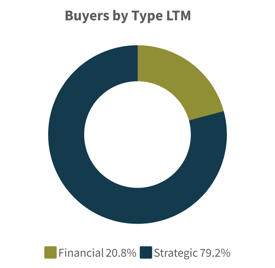 Strategic Acquirers: With 80 deals (79.2%), strategic buyers remained the dominant force, focused on expanding cross-border capabilities, geographic reach, and logistics infrastructure. C.H. Robinson Worldwide's $75 million acquisition of Despir Logistics exemplifies the strategic premium being placed on growing complex and high value logistics infrastructure.1
Financial Buyers: Accounting for 21 deals (20.8%), financial buyers meaningfully increased their share of activity from 8.8% in the prior year. Platform investments in asset-light and contracted-revenue logistics businesses — including Siris Capital Group's acquisition of Takkion Holdings and Tallvine Partners' investment in Lind Marine — reflect private equity's continued preference for scalable, defensible assets in a recovering freight environment.1
Even as deal volume softens across Transportation & Logistics, buyers are paying up — TEV/EBITDA has climbed to 12.19x and TEV/Revenue to 1.93x, a divergence that points to selective but high-conviction capital deployment into assets. The APEX transaction and the NextBooat deal are emblematic of this theme: acquirers are zeroing in on specialized platforms where contracted revenues and network scale justify premium entry points. Financial sponsors are increasingly part of this story, with their participation rising to 20.8%, reflecting a broader re-engagement with logistics assets that can weather near-term macro uncertainty.
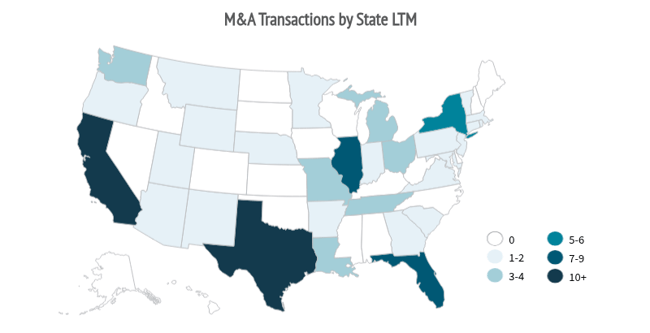
Top U.S. States: M&A activity was concentrated in major logistics and transportation hubs. Texas (18 deals), California (15), and Florida (9) led the nation, reflecting their importance in national supply chains, from port activity and cross-border trade to domestic distribution networks.1
Cross-Border Trends: The acquisition of Envoy Technologies by BladeRanger highlights the growing investor focus on the U.S.-Israel transportation, mobility, and logistics ecosystems. As companies continue to grow operations, M&A targeting cross-border logistics and technology platforms is expected to increase.
| Target | Buyer | Value ($mm) |
| Cross Border Xpress, L.L.C. | Grupo Aeroportuario del Pacífico, S.A.B. de C.V. | $2,200 |
| Despir Logistics LLC | C.H. Robinson Worldwide, Inc. | $75 |
| Envoy Technologies, Inc. | BladeRanger Ltd | $14 |
| APEX | NextBoat Inc. | $6 |
| Masterpiece International, Ltd. | Boxart Inc.; Maxwell Street Capital Partners, LP | n/a |
| Ally Global Logistics LLC | PLS Logistics Services | n/a |
| F2f Transport, LLC | LRT Solutions, Inc. | n/a |
| Leading Edge Holdings, LLC | Equivu Capital, LLC | n/a |
| LG Logistics Solutions LLC | Fura, Inc. | n/a |
| King Courier | Mercury Business Services, LLC | n/a |
| Target | Buyer | Value ($mm) |
| Stratton Final Mile Services LLC | Undisclosed | n/a |
| Lind Marine, Inc. | Tallvine Partners Management LP | n/a |
| Voyager Global Mobility LLC | Undisclosed | n/a |
| Takkion Holdings LLC | Siris Capital Group, LLC | n/a |
| Target | Buyer | Value ($mm) |
| Scl Cold Chain, LLC | RealCold | n/a |
| Corporate air Inc. | Infinity Aviation Services, LLC | n/a |
| Postal Connections | Annex Brands, Inc. | n/a |
| Evolve Supply Chain Solutions, Llc | iGlobal Exports, LLC | n/a |
| CSAT Solutions Holdings LLC | Verdant Solutions Limited | n/a |
Source S&P Capital IQ as of 7/2/2026 and PCE Proprietary Data
Opportunities: Compressed truckload valuations create a favorable window for bolt-on acquisitions, while automation-enabled third party logistics and cross-border specialists are likely to attract continued strategic interest as buyers seek capabilities that are difficult to build organically. Nearshoring infrastructure — warehousing, drayage, and customs logistics along the U.S.-Mexico corridor — should remain an active M&A theme as trade flows continue to reorient.3
Risks: Fuel cost volatility and sustained tariff uncertainty remain the most immediate headwinds, with potential to compress carrier margins just as rate recovery gains traction. The ongoing conflict in Iran has produced additional risk to diesel and jet fuel prices, as tensions in the region threaten to constrain global crude supply and widen spread volatility for U.S. carriers. Wage inflation in labor-intensive models — particularly last-mile and warehousing — continues to pressure unit economics for operators that have not yet automated.2
Predicted Activity: Expect continued consolidation in truckload as thin-margin operators seek scale or exit, alongside tuck-in acquisitions in warehousing and cross-border logistics. Financial buyers will likely remain selective, favoring asset-light platforms with contracted revenue, while strategic acquirers with strong balance sheets are well-positioned to act in LTL and freight tech.2

Michael Rosendahl |

Eric Zaleski |

Kyle Wishing |
Advised Western Milling in their sale to the Western Milling ESOP Trust
